
The sun brings us the sunshine and warmth necessary for life, provides the necessary conditions for the production of oxygen, and provides the driving force for the growth of all things. It can be said that the sun is the incubator of life, but this incubator also has its dangerous side.
Coronal mass ejection ((CME)) is material ejected from the sun's corona and can usually be observed in white light using a coronometer. The ejected material is mainly plasma made up of electrons and protons (in addition to a small amount of heavy elements such as helium, oxygen and iron), plus the accompanying coronal magnetic field.
(R. Tousey (1973) the seventh solar orbital observation (SOS-7) on December 14, 1971, the largest geomagnetic disturbance was first observed by Richard Christopher Carrington in 1859 and is presumed to have been caused by a coronal mass ejection since records began. The magnetic storm caused by the flare was observed and recorded by a geomagnetic intensity meter at the National Botanical Garden in the western suburbs of London.
When the projectile reaches Earth, it is called interplanetary coronal mass ejection, which may disrupt the Earth's magnetosphere, compress toward the sun and extend into a tail. When the magnetosphere on the back side of the sun is reconnected, it creates several megawatts of energy that pours into the upper atmosphere from behind the earth. This process results in particularly strong auroras (aurora borealis, which often occurs in the North Pole, and aurora borealis in the South Pole). Coronal mass ejection events are accompanied by flares that disrupt radio transmission, cause energy loss (power outage), and cause damage to satellites and power transmission lines. Coronal mass ejection ((CME)) is the largest and most intense energy release process in the solar system. A single burst can release up to 10 ^ 32 ergs of energy and 10 ^ 16 grams of solar plasma into interplanetary space, accompanied by 10keV-1GeV 's high-energy particle flow. When CME explodes, it throws out a large amount of plasma and consolidates the magnetic field structure (magnetic flux) in it. A large amount of matter and huge energy will produce shock waves in the solar atmosphere and interplanetary space, causing geomagnetic storms, ionospheric storms and auroras in near-Earth space. Traditionally, people usually divide the solar phenomenon into quiet solar phenomenon and active solar phenomenon. The explosive phenomena in the active solar phenomenon mainly include solar flares, explosive prominences and coronal mass ejection ((CME),), among which coronal mass ejection is the most intense. The main feature of these outbreaks is the release of a great deal of energy in a very short time (tens of minutes).
Because the sun is very close to the earth, the release of this energy may have a serious impact on the earth. Known include impacts on space exploration and aerospace, on satellite operations and communications, on ground-based communications dependent on the ionosphere, and on Electroweb and power facilities, and even pipelines. Its influence can be said to cover all aspects of people's lives on earth.
Mars, here we come! The mysterious experimental site of the Chinese exploration mission was unveiled for the first time.
According to the China Youth Daily, Huailai, Hebei, November 14 (Reporter Qiu Chenhui) Today, the National Space Administration successfully carried out a hovering obstacle avoidance test of China's first Mars exploration mission lander at the comprehensive test site for the landing of extraterrestrial objects in Huailai, Hebei Province. This is also the first public appearance of China's Mars exploration mission.
Mars exploration is the hot spot of exploration and the strategic commanding height of space technology in the major spacefaring countries, and it has become the preferred target of planetary exploration. According to the plan, China's first Mars exploration mission is scheduled to be carried out in 2020, and strive to achieve the three major goals of \"circling\" and \"patrolling\" in one step. specifically, it is to circle and land Mars through a launch mission. carry out global and comprehensive exploration of Mars, and fine inspection and exploration of key areas on the surface of Mars.
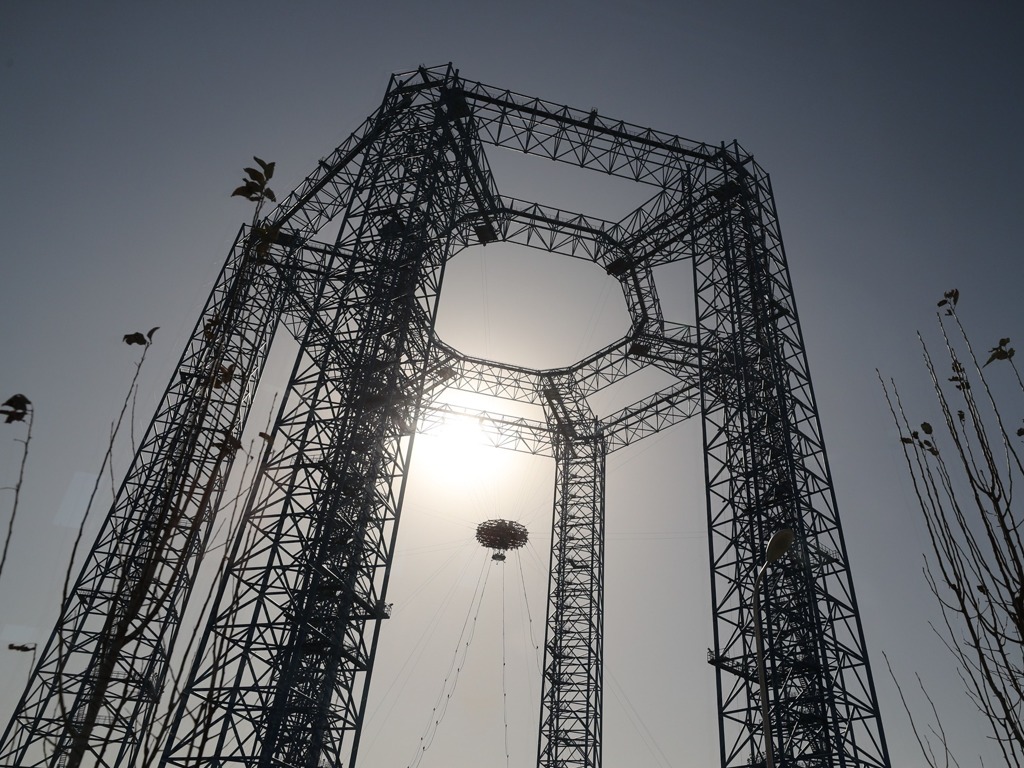
Among them, safe landing is one of the most difficult challenges of Mars exploration mission. According to Zhang Rongqiao, chief designer of China's first Mars exploration mission, after the launch of China's first Mars probe, it will take about seven months to fly to Mars and finally land on Mars. Only seven minutes-this process will be the most difficult part. The natural environment of Mars is different from that of the earth, and its gravity is only 1par 3 of that of the earth. In order to simulate the landing in the Martian gravity environment, the researchers need to carry out the lander hover obstacle avoidance test on the ground, and build a corresponding test site for this purpose.
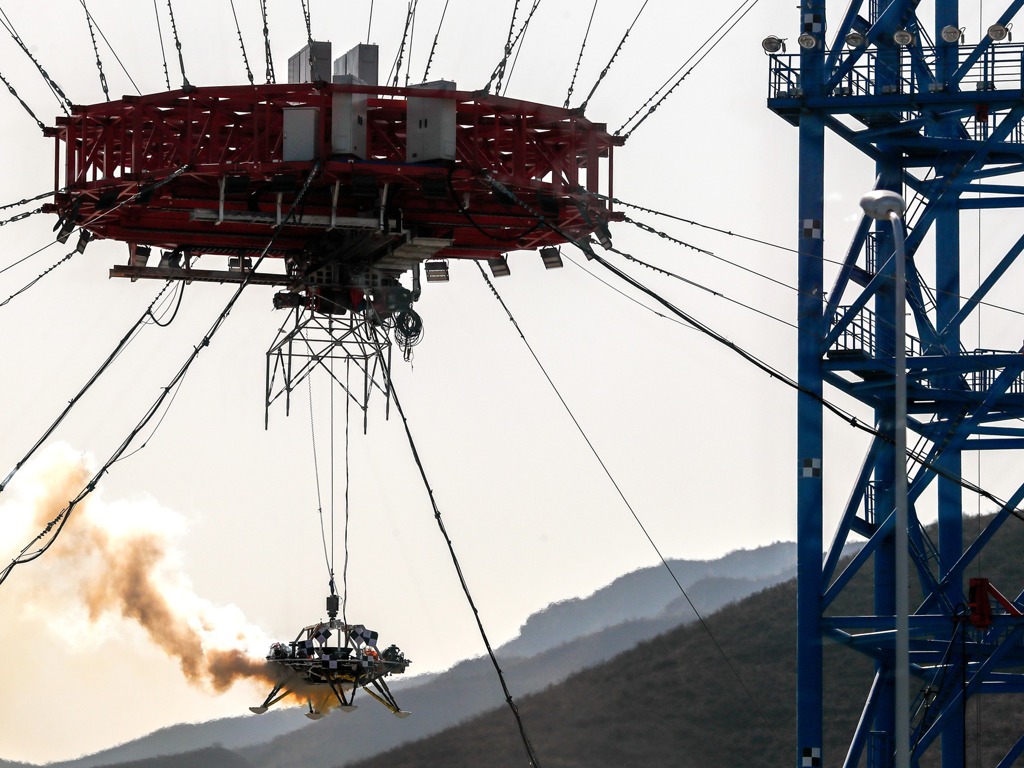
The Hebei Huailai comprehensive test site for the landing of extraterrestrial objects, which was tested on the same day, is the largest comprehensive test site for the landing of extraterrestrial objects in Asia. China Youth Daily China Youth Network reporter saw at the scene that the lander hover obstacle avoidance test simulated the lander in the Martian environment hovering, obstacle avoidance, slow descent and other processes. Zhang Rongqiao said that the main simulation of the day's test was that the lander broke away from the main spacecraft at an altitude of 70 meters, then descended, hovered at an altitude of 67 meters, looked for a suitable landing site on the surface of Mars, and then avoided obstacles and descended to an altitude of 20 meters. This test can simulate the whole process of the lander landing on the Martian surface and comprehensively verify the correctness of the lander design.
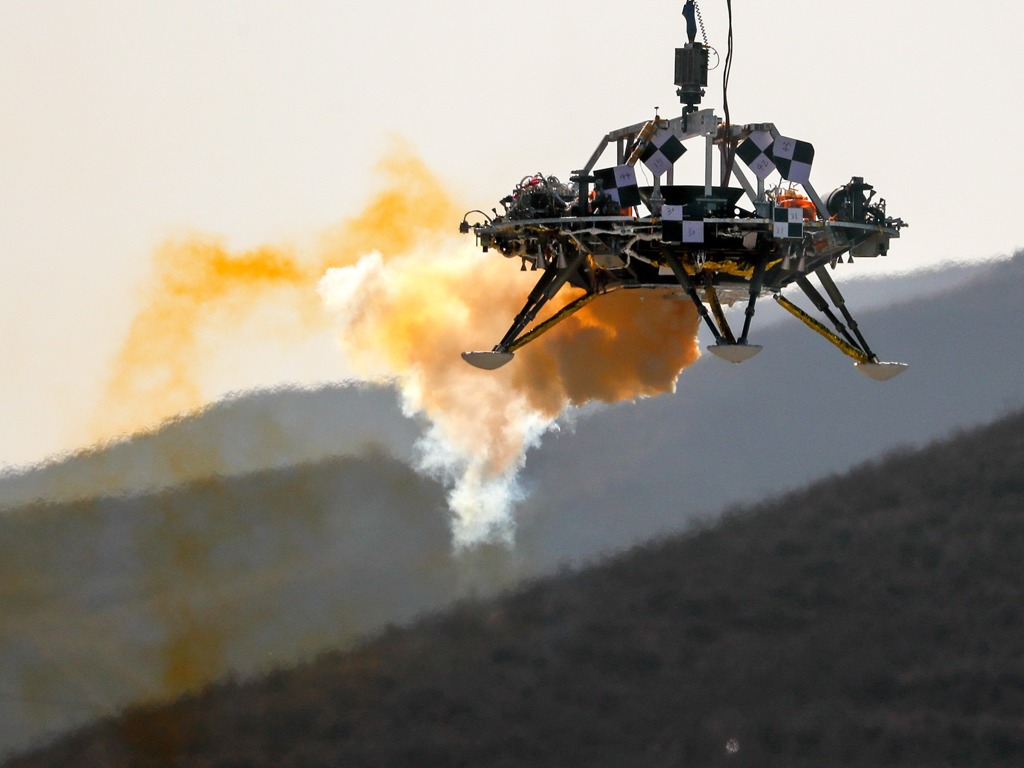
The reporter also learned from the National Space Administration that so far, China's first Mars exploration mission is progressing smoothly. Prior to this, the relevant loads have been basically determined, and the probe has a total of 13 payloads, including 7 on the orbiter and 6 on the rover, involving space environment exploration, Mars surface exploration, Mars surface structure exploration and other fields.